The Mole History+Examples
History:
The Mole was created by a man named Amedeo Avogadro. Avogadro was an Italian physics professor who proposed, in 1811, that gases at the same temperature contain equal numbers of molecules. At that time there was no data on the number of particles in a mole, or an agreement on any atomic weights or the standard. The first measurements, which could give an approximate value for Avogadro's number, were observations of browmain motion by Robert Brown in 1827.
Cannizarro, in 1860, used the Avogadro's hypothesis to develop a defensible set of atomic weights, based on 1/16 of the atoms weight of oxygen, for the known elements by comparing the masses of equal volume of gas. This was the basis for progressively more accurate estimates for Avogadro's number over the next 100 year. Building on his work, an Austrian high school teacher named Johann Josef Loschmidt calculated the size of a molecule of air in 1865, and then developed an estimate for the number of molecules in a given volume of air. While these early estimates have since been refined, they led to the concept of the mole- that is, the theory. More than just one scientist experimented with Avogadro's work. Reasonable values were available in the late 1800's from sedimentation equilibria of colloidal particles Millikan's oil drop experiment in the early 1900's gave improved accuracy and was cited in most chemistry books 50 years ago. Text books in 1958 gave Avogadro's number as 6.02x10^23, which is still used today. The current value is 6.022137x10^23. If you would like to understand why and how they shorten Avogadro's number please visit .www.chem1.com/acad/webtext/intro/int-2.html
To be able to understand Avogadro's number is very difficult, so let me explain it! Some idea is given by the following calculation. Let us suppose that the entire state of Texas, with an area of 262,000 square miles, were covered with a layer of fine sand 50 feet thick, each grain of sand being 1/100 of an inch in diameter. There would then be Avogadro's number of sand particles in this immense sand pile. There would be the same number of molecules of water in both- 18g, 1/25 of a pint.
Now here is a good example of how the Mole works!
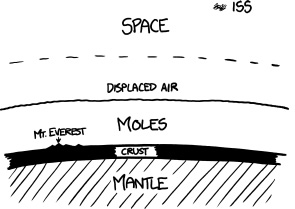
As you can probably guess, a mole (6.02 x 10^23) is a VERY large number. But, what does a mole of moles look like? What if we release a mole of moles onto our planet?
Mammals are largely water. A kilogram of water takes up a liter of volume, so if the moles weigh 4.52×10^22 kilograms, they take up about 4.52×10^22 liters of volume. You might notice that we’re ignoring the pockets of space between the moles. In a moment, you’ll see why.
The cube root of 4.52×10^22 liters is 3,562 kilometers, which means we’re talking about a sphere with a radius of 2,210 kilometers, or a cube 2,213 miles on each edge. (That’s a neat coincidence I’ve never noticed before—a cubic mile happens to be almost exactly 4/3pi cubic kilometers, so a sphere with a radius of X kilometers has the same volume as a cube that’s X miles on each side.)
If these moles were released onto the Earth’s surface, they’d fill it up to 80 kilometers deep—just about to the (former) edge of space.